ASRS v1.1: Adult ADHD Self‑Report Scale v1.1
Free ASRS v1.1 adult ADHD screener with all 18 questions, Part A shaded-box guidance, instant scoring, and a downloadable PDF for follow-up with a clinician.
Last updated
What Is the ASRS v1.1 Adult ADHD Screener?
The Adult ADHD Self‑Report Scale (ASRS) v1.1 is an 18‑item adult ADHD screening questionnaire developed with the World Health Organization. It asks how often ADHD-related symptoms have affected daily life over the past 6 months. Scores can indicate when a full clinical evaluation may be useful, but the ASRS does not diagnose ADHD.
The ASRS includes a short Part A screener and a longer Part B symptom checklist. The original paper form uses shaded response boxes in Part A; four or more shaded-box responses is commonly treated as a positive screen that should be followed by a comprehensive clinical evaluation.
Part A vs Part B: What's the difference?
- Part A (6 items): Short screener most predictive of ADHD diagnosis. Focuses on core symptoms with highest diagnostic accuracy.
- Part B (12 items): Additional symptom severity and functional impact. Provides broader clinical context.
- Both parts use identical 0–4 scoring ("Never" to "Very Often") over past 6 months.
Understanding ASRS Shaded Boxes Scoring
The original paper ASRS form uses shaded boxes to highlight clinically significant responses. If your answer falls in a shaded box, it counts toward a positive screen. Here's how the shaded thresholds work for Part A:
| Question | Shaded Box Threshold |
|---|---|
| Q1 (wrapping up details) | Sometimes, Often, or Very Often |
| Q2 (difficulty organizing) | Sometimes, Often, or Very Often |
| Q3 (remembering appointments) | Sometimes, Often, or Very Often |
| Q4 (avoiding tasks) | Often or Very Often |
| Q5 (fidgeting) | Often or Very Often |
| Q6 (feeling driven) | Often or Very Often |
Traditional interpretation: If 4 or more of your Part A responses fall in shaded boxes, the screen is positive for ADHD. This online version also reports numeric Part A, Part B and total scores for easier tracking, but the shaded-box rule is the canonical quick-screen interpretation.
Why it matters: ADHD persists into adulthood for many people and can significantly affect relationships, career and quality of life. Yet adult ADHD is frequently under‑diagnosed. The ASRS offers a quick, self‑administered way to identify individuals whose symptom pattern warrants further evaluation. Studies report high internal consistency (Cronbach's alpha ≈ 0.88) and strong concurrent validity (r ≈ 0.84). More recent factor analytic work confirms a two‑factor structure (inattention and hyperactivity/impulsivity) with excellent reliability (α ≈ 0.95 for the full scale and ≈ 0.92 for each subscale).
Evidence & scoring: The canonical Part A scoring rubric counts how many of your six responses fall within the darkly shaded boxes — four or more shaded responses is a positive screen (Kessler et al., 2005). Some clinicians and researchers also report a numeric Part A score (sum of 0–4 ratings, range 0–24) for tracking change over time, but there is no consensus numeric cutoff for v1.1; the canonical positive screen remains the dichotomous shaded-box count. Part B (12 items, scored similarly, range 0–48) provides context about broader symptom severity. The combined 18‑item total (range 0–72) can be compared with normative data when used for population-level work.
Validation findings: The original WHO/Kessler validation (Kessler et al., 2005) reported the 6‑item screener at the dichotomous shaded-box cutoff achieves high specificity (≈99.5%) with moderate sensitivity (≈68.7%). Later workforce-validation work (Kessler et al., 2007) reported higher accuracy in employee samples. Adler et al. (2006) reported strong internal consistency (Cronbach's α ≈ 0.88) and inter-rater reliability (ICC ≈ 0.84) for clinical use. Reported numbers vary across populations and cutoffs; consult the primary literature for the cutoff and population most relevant to your use case.
Important note: The ASRS is a screening tool—it does not confirm or rule out ADHD. A positive screen should lead to a comprehensive clinical interview assessing childhood history, functional impairment and potential comorbidities. Clinicians may combine the ASRS with the Wender Utah Rating Scale (WURS) to evaluate retrospective childhood symptoms. If you or your patient scores in the high or very high range, consult a qualified healthcare professional for a full evaluation.
Crisis support: If you experience thoughts of self-harm or severe distress, call the 988 Suicide & Crisis Lifeline immediately.
Ready to Begin?
This assessment takes about 5 min to complete. Your responses are private, never stored, and you can instantly download your results as a PDF.
How to Take the ASRS v1.1 Online
Answer Questions
Complete the assessment honestly based on how you've been feeling
Get Your Score
Instant calculation using clinically validated scoring methods
Download PDF
Save or share your detailed results with your provider
Answer 18 questions about how often you have experienced specific ADHD‑related behaviours over the past 6 months. Each response is scored from 0 (Never) to 4 (Very Often). The first six questions (Part A) form the short screener. Add up the scores from those items to obtain a Part A score (range 0–24). Repeat the process for the remaining twelve questions to calculate a Part B score (range 0–48). Summing all 18 responses yields the total score (range 0–72).
After completing the questionnaire, compare your scores with the interpretive ranges below. Higher scores indicate greater frequency of ADHD symptoms. Remember that the ASRS is not diagnostic—use it to guide conversations with healthcare providers.
ASRS v1.1 Scoring, Shaded Boxes, and Interpretation
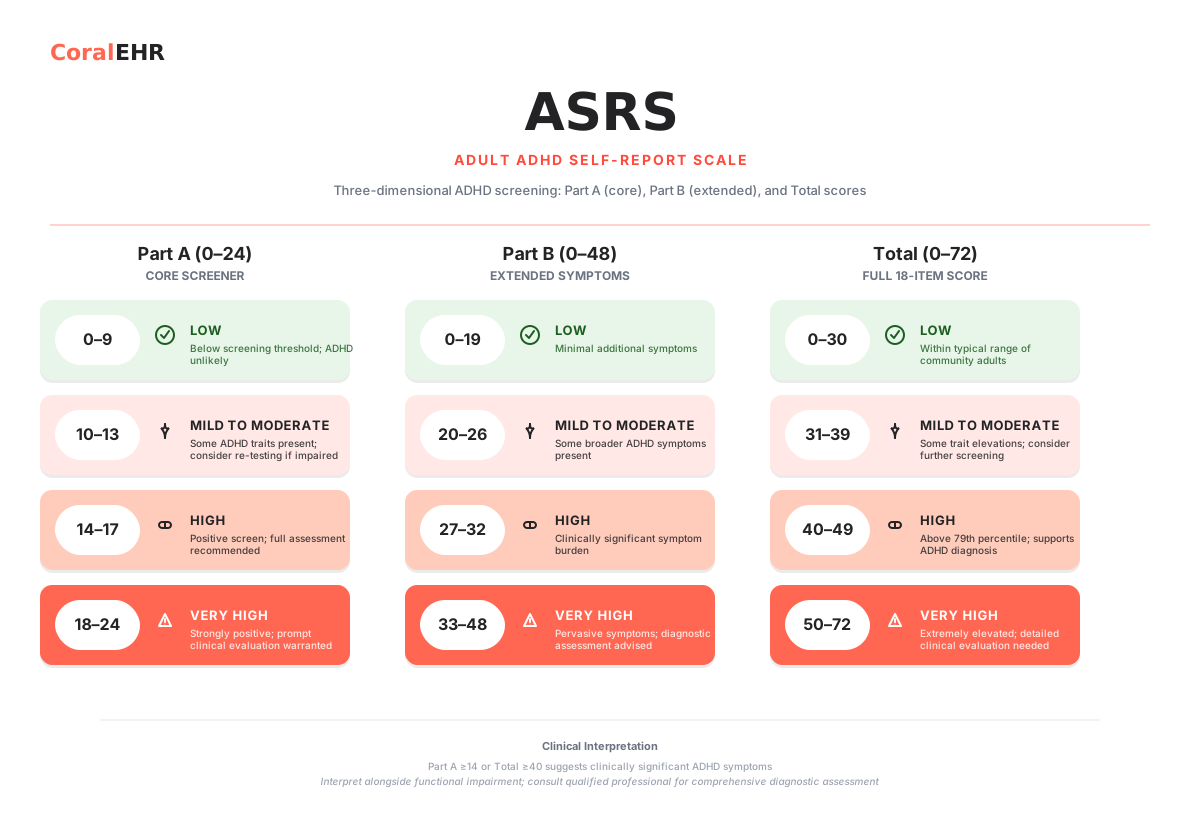
Part A (0–24 points):
- Low (0–9): Symptoms are below screening threshold. ADHD is unlikely, but monitor if functional impairments persist.
- Mild to Moderate (10–13): Some ADHD traits are present. Consider re‑testing or discussing with a clinician if impairments are significant.
- High (14–17): Positive screen. Your responses are consistent with the symptom pattern commonly reported by adults later evaluated for ADHD. The ASRS items map to DSM-IV-TR Criterion A symptoms; a current ADHD diagnosis is made by a clinician under DSM-5-TR and additionally requires evidence of onset before age 12, cross-setting impairment, and exclusion of other causes. A comprehensive evaluation is recommended.
- Very High (18–24): Strongly positive screen. Symptoms are frequent and likely cause significant impairment. Prompt clinical evaluation is warranted.
Part B (0–48 points):
- Low (0–19): Minimal additional symptoms.
- Mild to Moderate (20–26): Some broader ADHD symptoms. Monitor functioning and discuss concerns with a professional if needed.
- High (27–32): Clinically significant symptom burden. Seek a comprehensive evaluation.
- Very High (33–48): Symptoms are pervasive across settings. A diagnostic assessment is strongly advised.
Total Score (0–72 points):
- Low (0–30): Scores fall within the typical range of community adults.
- Mild to Moderate (31–39): Some trait elevations. Consider further screening or monitoring.
- High (40–49): Elevated symptom burden. Combined with a positive Part A shaded-box screen, this supports follow-up with a clinician.
- Very High (50–72): Extremely elevated symptoms. A detailed clinical evaluation is needed.
Using your results: A Part A score ≥14 or Part B score ≥27 suggests elevated ADHD symptom burden. Use the scores to facilitate discussions with a mental health provider. Always interpret results in the context of your personal history and current functioning.
Frequently Asked Questions
Common questions about the ASRS v1.1 assessment.
- Four or more shaded-box responses in Part A is the canonical positive screen for adult ADHD and means your symptom pattern is consistent with what adults later evaluated for ADHD commonly report. A positive screen is a signal to seek a comprehensive clinical evaluation, not a diagnosis. The shaded thresholds are stricter for items 4-6 (Often or Very Often) than for items 1-3 (Sometimes, Often, or Very Often).
- They are two different ways of reading Part A. The canonical screen is dichotomous: count how many of your six responses land in the darkly shaded boxes, with four or more being a positive screen. This online version also reports a numeric Part A score (0-24) for tracking change over time, where roughly 14 or higher flags an elevated burden, but there is no consensus numeric cutoff for v1.1, so the shaded-box count remains the standard interpretation.
- No. The ASRS is a screening tool and cannot confirm or rule out ADHD, so a positive screen only indicates that a full evaluation is warranted. A clinical diagnosis additionally requires evidence of symptom onset before age 12, impairment across more than one setting, and exclusion of other conditions such as anxiety, depression, or sleep disorders. Bring your results to a licensed professional for a comprehensive assessment.
- The Adult ADHD Self‑Report Scale (ASRS) v1.1 is a self‑administered questionnaire created by the World Health Organization and Harvard researchers to screen for ADHD symptoms in adults. It contains 18 items reflecting DSM‑IV‑TR criteria, with a six‑item short screener (Part A) that is highly predictive of an ADHD diagnosis. The tool was designed to provide a quick, standardized method for identifying adults who may benefit from a full clinical evaluation. Adult ADHD often goes undiagnosed despite causing significant impairment in work, relationships and daily functioning. The ASRS fills a critical gap by offering a validated, accessible screening tool that can be completed in about 5 minutes. Adult ADHD prevalence is estimated at roughly 4.4% (Kessler et al., 2006, NCS-R), with more recent CDC surveys reporting somewhat higher rates; many adults remain unidentified until later in life.
- Each item uses a five‑point frequency scale: Never = 0, Rarely = 1, Sometimes = 2, Often = 3, Very Often = 4. Add the first six items to obtain your Part A score (0–24). A score of 14 or more is considered a positive screen. Sum the remaining twelve items to get a Part B score (0–48); scores of 27 or higher are clinically significant. Combining all 18 items yields a total score (0–72) that can be compared to normative data—scores 40 or more fall above the 79th percentile in the general population.
- The ASRS has been studied across many populations. The original WHO/Kessler validation (Kessler et al., 2005) reported the 6‑item screener at the dichotomous shaded-box cutoff has high specificity (~99.5%) with moderate sensitivity (~68.7%). Adler et al. (2006) reported strong internal consistency (Cronbach's α ≈ 0.88) and inter-rater reliability (ICC ≈ 0.84) for clinical use. Reported numbers vary across populations and cutoffs — consult the primary literature for the cutoff and population most relevant to your use case.
- Yes. The ASRS has been translated and validated in multiple languages including Spanish, Arabic, Korean, Japanese, Thai and many others. For example, a Thai adaptation showed Cronbach's α ≈ 0.86 for the full scale and reported that using four or more responses in the darkly shaded boxes of Part A (the original dichotomous scoring) produced 90.91% sensitivity and 62.5% specificity. Cross-cultural studies consistently demonstrate that the ASRS maintains its factor structure and reliability across diverse populations. These findings support the tool's cross‑cultural applicability, although optimal cut‑off points may vary slightly across populations based on cultural differences in symptom expression and reporting. When using translated versions, ensure they have been formally validated in the target population.
- A high Part A score (≥14) or a high total score (≥40) suggests that your symptoms are consistent with ADHD. However, the ASRS cannot diagnose the disorder. If you screen positive, consult a licensed mental health professional or physician for a comprehensive assessment. A thorough evaluation will consider your childhood history (ADHD symptoms must be present before age 12), functional impairments across multiple settings, and other conditions that may mimic or coexist with ADHD such as anxiety, depression or sleep disorders. Tools like the Wender Utah Rating Scale (WURS) can help assess childhood symptoms retrospectively. Many adults with ADHD also experience comorbid conditions—consider screening for anxiety with the [GAD-7](/assessments/gad-7) or depression with the [PHQ-9](/assessments/phq-9) to provide your clinician with a complete picture.
- Your responses are processed entirely in your browser - nothing is transmitted to or stored on our servers, so no protected health information leaves your device. Note: HIPAA compliance is a property of an organization's policies and Business Associate Agreements, not of a website. Clinicians using this tool inside a practice should follow their EHR's HIPAA workflow.
- If you are monitoring ADHD symptoms during treatment, administering the ASRS every few months can track changes over time. Because the questionnaire asks about behaviours over the past six months, avoid taking it more frequently than that. Always interpret your scores in consultation with a healthcare provider.
- Part A consists of 6 items that were selected through extensive psychometric analysis as the most predictive of an ADHD diagnosis. These items capture core symptoms with the highest diagnostic accuracy and are weighted toward inattention. Part A can be used as a standalone screener in time-limited settings. Part B contains 12 additional items that assess a broader range of ADHD symptoms including hyperactivity, impulsivity and functional impairment across various life domains. While Part B doesn't contribute to the initial screening decision, it provides valuable clinical information about symptom severity and helps clinicians understand which domains are most affected. Using both parts together gives the most comprehensive assessment of adult ADHD symptoms.


Stay Updated on Mental Health Resources
Get notified when we add new assessments, research insights, and mental health resources.