CY‑BOCS: Children’s Yale‑Brown Obsessive Compulsive Scale
Ten questions covering obsessive and compulsive symptoms rated from 0 (none) to 4 (extreme). Provides obsession, compulsion and total scores with evidence‑based cut‑offs.

Understanding the CY‑BOCS: Measuring Childhood OCD Severity
The Children's Yale‑Brown Obsessive Compulsive Scale (CY‑BOCS) is a semi‑structured interview used by clinicians to assess the severity of obsessive and compulsive behaviours in children and adolescents. Developed as an adaptation of the adult Yale–Brown Obsessive Compulsive Scale (Y‑BOCS), the CY‑BOCS employs simpler language and is considered the gold‑standard instrument for measuring obsessive–compulsive disorder (OCD) severity in youth. It was originally designed for patients aged 8–16 years, though it is often used across the broader 6‑ to 17‑year range in clinical practice.
The scale consists of 10 items that separately rate obsessions and compulsions across five dimensions:
The Five Dimensions of OCD Assessment:
- Time Occupied: Hours per day consumed by obsessive thoughts or compulsive rituals
- Interference: Impact on school, social activities and family relationships
- Distress: Level of anxiety or upset when obsessions/compulsions are prevented
- Resistance: Child's effort to resist or fight against the symptoms
- Degree of Control: Success in controlling or stopping the symptoms
Each question is scored from 0 (none) to 4 (extreme), yielding an obsession subscore (items 1–5), a compulsion subscore (items 6–10) and a total score (0–40) by summing both subscores.
Why it matters: Childhood OCD affects up to 2 % of youths and often impairs social, academic and family functioning. Early identification and measurement of symptom severity are critical for guiding treatment and monitoring response to therapy. The CY‑BOCS has strong psychometric support—studies in children with tic disorders report Cronbach's α≈0.81 and test–retest reliability ≈0.82. Research comparing the CY‑BOCS with the Y‑BOCS shows that both scales capture obsessive and compulsive symptom dimensions similarly but the CY‑BOCS is better suited for younger populations.
Evidence & scoring: Higher CY‑BOCS scores indicate greater symptom severity. In a large Chinese sample, mean total scores were 3.93 ± 5.15 among children with tic disorders. Severity categories have been established: 0–7 is considered subclinical, 8–15 mild, 16–23 moderate, 24–31 severe, and 32–40 extreme. A total score of 8 or more suggests OCD symptoms at a clinically meaningful level, while scores 16 or higher indicate moderate to severe impairment warranting prompt evaluation.
Crisis support: If your child's OCD symptoms lead to severe distress, self-harm thoughts or significantly impair daily functioning, seek immediate professional help. Call the 988 Suicide & Crisis Lifeline for urgent support.
Ready to Begin?
This assessment takes about 5–10 min to complete. Your responses are private, never stored, and you can instantly download your results as a PDF.
How to Use the CY‑BOCS
Answer Questions
Complete the assessment honestly based on how you've been feeling
Get Your Score
Instant calculation using clinically validated scoring methods
Download PDF
Save or share your detailed results with your provider
Answer 10 questions about your child’s obsessive thoughts and compulsive
behaviours during the past week. For each item, select the option that
best describes the average severity:
- 0 (None): No symptoms or minimal impact.
- 1 (Mild): Symptoms are present but cause little interference.
- 2 (Moderate): Symptoms are noticeable and somewhat impairing.
- 3 (Severe): Symptoms are frequent and significantly impairing.
- 4 (Extreme): Symptoms are nearly constant and disabling.
Add the scores for items 1–5 to obtain the obsession subscore (range 0–20). Sum items 6–10 for the compulsion subscore (range 0–20). The total CY‑BOCS score is the sum of both subscores (range 0–40). Compare your total score with the interpretive ranges below to understand severity and guide next steps. Remember that the CY‑BOCS is a clinician‑administered tool; this online version provides general guidance but cannot replace a formal diagnostic evaluation.
CY‑BOCS Scoring Interpretation
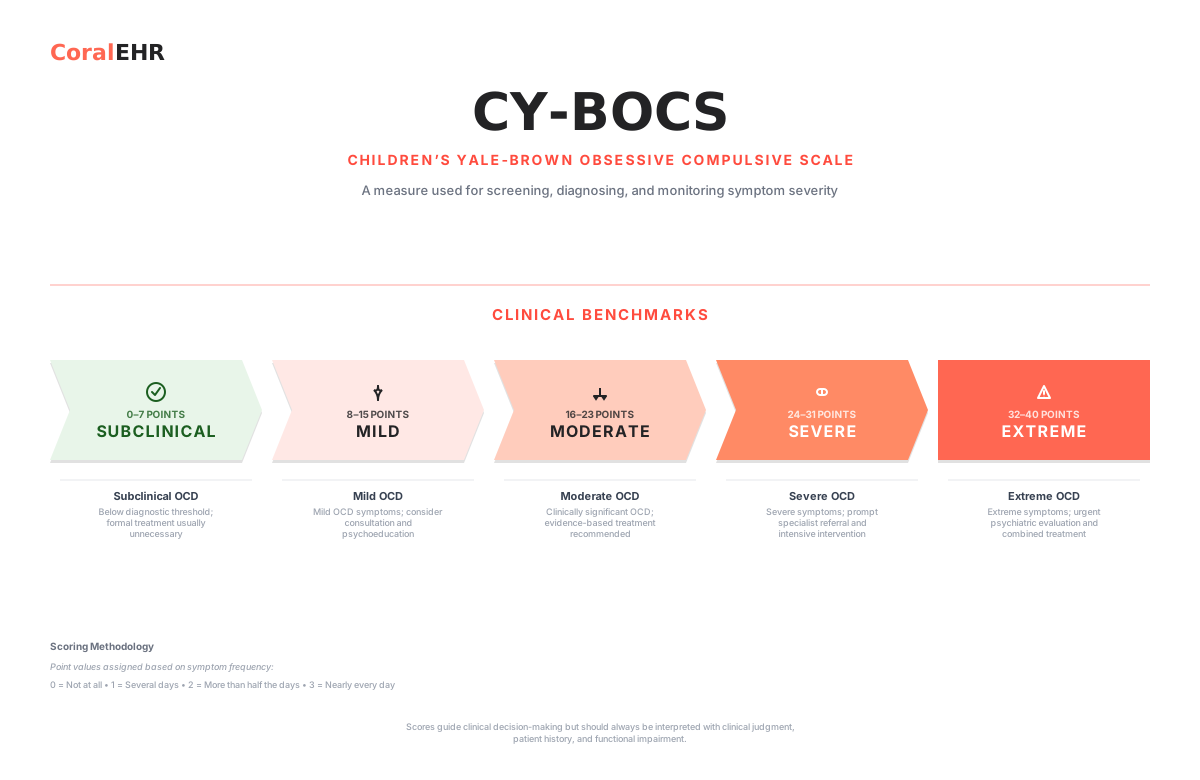
Total Score (0–40 points):
- Subclinical (0–7): Obsessive and compulsive symptoms fall within
typical variation and are unlikely to meet diagnostic criteria. Monitor
occasionally but formal treatment is usually unnecessary. - Mild (8–15): Mild OCD symptoms are present and may cause distress or
minor impairment. Consider an initial consultation with a mental health
professional, psychoeducation and supportive interventions. - Moderate (16–23): Moderate symptom severity suggests clinically
significant OCD. A comprehensive assessment and evidence‑based treatment
(e.g., cognitive‑behavioural therapy with exposure and response prevention)
are recommended. - Severe (24–31): Symptoms are severe and likely interfere substantially
with daily functioning. Prompt specialist referral and intensive
intervention are warranted. - Extreme (32–40): Symptoms are extreme, pervasive and disabling. Urgent
psychiatric evaluation is necessary; consider combining therapy with
pharmacologic treatment.
Using your results: A score of 8 or higher indicates clinically significant OCD symptoms. Scores in the moderate or above range (16 +) call for a comprehensive evaluation by a qualified clinician. Total scores should always be interpreted alongside clinical history, functional impairment and comorbid conditions.
Frequently Asked Questions
Common questions about the CY‑BOCS assessment.


Stay Updated on Mental Health Resources
Get notified when we add new assessments, research insights, and mental health resources.