GAD‑7: Generalized Anxiety Disorder 7‑Item Scale
The GAD‑7 assessment is a clinically validated tool for assessing generalized anxiety severity. Answer seven questions to get an instant score and guidance about what it means.
GAD-7 Questionnaire Explained: An Anxiety Screening Tool
The Generalized Anxiety Disorder 7‑item (GAD‑7) scale is a brief, self‑administered questionnaire used to assess the presence and severity of generalized anxiety symptoms over the past two weeks. Developed in 2006 by Robert L. Spitzer and colleagues, the GAD‑7 condenses core DSM criteria into seven questions. Despite its brevity, research shows that it has strong psychometric properties and can also screen for other anxiety disorders such as panic disorder, social anxiety and post‑traumatic stress. The tool has been validated for adults and adolescents aged 14 and older.
Evidence & validation: The original validation study found that a cut‑off score of 10 yields high sensitivity (about 89%) and specificity (about 82%) for detecting generalized anxiety disorder. A score of 8 or greater may optimize sensitivity without substantially reducing specificity. As with depression screening tools, the GAD‑7 offers a reliable and quick assessment for routine use in primary care and mental health settings.
Why use it? Anxiety disorders are among the most common mental health conditions and often go undetected. The GAD‑7 empowers you to quantify worrying, restlessness, irritability and other symptoms, making it easier to track changes and facilitate conversations with your therapist. Evidence suggests that repeated use (every 2–4 weeks) helps monitor treatment progress and guide interventions.
Alternatives: Shorter versions like the GAD‑2 (two questions) can be used for initial screening, with a positive result prompting the full GAD‑7. Other instruments include the Hamilton Anxiety Rating Scale (HAM‑A), Hospital Anxiety and Depression Scale (HADS), State‑Trait Anxiety Inventory (STAI) and the Generalized Anxiety Disorder Questionnaire‑IV.
Important disclaimer: The GAD‑7 is a screening and monitoring tool. It cannot diagnose anxiety disorders. If your score falls in the moderate or severe range or you feel overwhelmed by anxiety, seek professional help. In the U.S., you can call the 988 Suicide & Crisis Lifeline.
Reference: View the original GAD‑7 questionnaire (PDF) from the American Psychiatric Association.
Ready to Begin?
This assessment takes about 2-3 min to complete. Your responses are private, never stored, and you can instantly download your results as a PDF.
How to Take the GAD-7 Anxiety Test Online
Answer Questions
Complete the assessment honestly based on how you've been feeling
Get Your Score
Instant calculation using clinically validated scoring methods
Download PDF
Save or share your detailed results with your provider
You'll answer seven questions about how often you've been bothered by specific anxiety symptoms during the past two weeks. Each response is scored from 0 (Not at all) to 3 (Nearly every day), producing a total score between 0 and 21.
Common GAD-7 Symptoms Include:
- Feeling nervous, anxious or on edge
- Not being able to stop or control worrying
- Worrying too much about different things
- Trouble relaxing
- Being so restless that it's hard to sit still
- Becoming easily annoyed or irritable
- Feeling afraid that something awful might happen
Most people complete the questionnaire in just a couple of minutes.
GAD-7 Scoring Guidelines and Clinical Interpretation
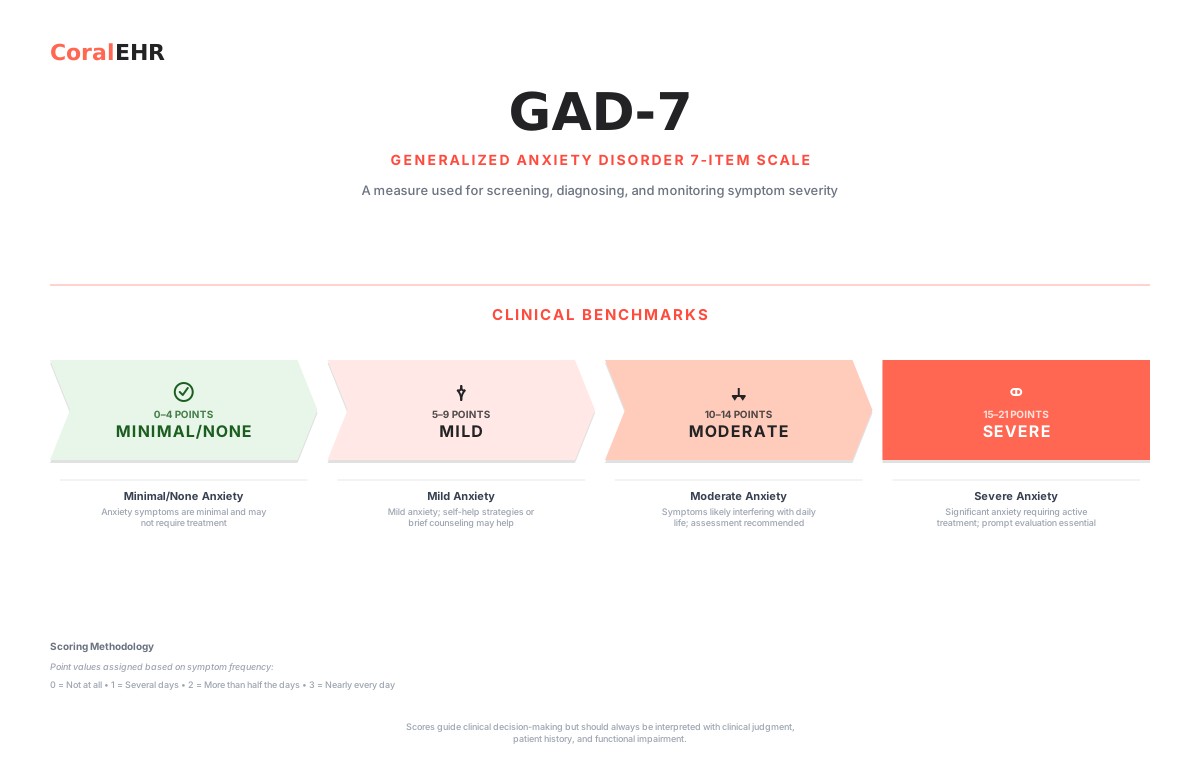
0–4 (Minimal/None): Anxiety symptoms are minimal and may not require treatment. Continue to monitor your mental health and retake the GAD‑7 periodically.
5–9 (Mild): Mild anxiety that might be situational. Self‑help strategies (e.g., relaxation techniques) or brief counseling may help. Reassess in two weeks.
10–14 (Moderate): Symptoms are likely interfering with daily life. A comprehensive assessment by a healthcare provider is recommended to discuss psychotherapy or medication options.
15–21 (Severe): Significant anxiety requiring active treatment. This often involves cognitive‑behavioral therapy, medication or a combination. Prompt evaluation and close follow‑up with a mental health professional are essential.
When to Seek Professional Help:
- Score of 10 or above on a single administration
- Score of 8 or above on two consecutive administrations (2-4 weeks apart)
- Any score combined with significant functional impairment (missing work, avoiding social situations, difficulty sleeping)
- Worsening scores despite self-help efforts
- Co-occurring depression symptoms (consider also taking the PHQ-9)
What Each Item Tells You:
- Items 1-2 (nervous/worry): Core cognitive symptoms of generalized anxiety. These two items alone form the GAD-2 ultra-brief screener.
- Items 3-4 (excessive worry/trouble relaxing): Somatic and cognitive tension. High scores here often respond well to relaxation-based interventions.
- Items 5-6 (restlessness/irritability): Behavioral manifestations. High scores may indicate the anxiety is affecting relationships and daily functioning.
- Item 7 (feeling afraid): Catastrophic thinking. Elevated scores here may suggest panic features worth exploring further.
Tracking Progress Over Time: A decrease of 4 or more points between administrations represents a clinically meaningful improvement. Many therapists administer the GAD-7 at intake and every 2-4 weeks to monitor treatment response. If scores plateau after 6-8 weeks of treatment, discuss adjusting the approach with your provider.
Using your results: You can download or print your score to share with your therapist. Keep a record if you're monitoring treatment progress. Remember, the GAD-7 guides discussions but does not provide a diagnosis.
Crisis support: If you experience severe anxiety, panic attacks or thoughts of self-harm, seek immediate help. Call the 988 Suicide & Crisis Lifeline for support.
Frequently Asked Questions
Common questions about the GAD‑7 assessment.
- A score of 12 falls in the 10-14 (moderate) band, meaning anxiety symptoms are likely interfering with daily life and a professional evaluation is recommended. Because 12 is above the clinical cut-off of 10, it suggests clinically significant anxiety worth discussing with a provider. This is a screening result rather than a diagnosis, so a clinician would confirm what is driving the symptoms.
- No. The GAD-7 screens for and measures the severity of anxiety symptoms but cannot diagnose an anxiety disorder. A clinician considers symptom duration, functional impairment, medical history, and alternative explanations such as thyroid issues or medication side effects before diagnosing. A score above 10 simply indicates that a more detailed assessment is warranted.
- The GAD-7 measures anxiety symptoms (0-21 scale, 7 items) while the PHQ-9 measures depression symptoms (0-27 scale, 9 items). They assess different conditions, and because anxiety and depression frequently co-occur, many clinicians administer both to screen for comorbidity. If your GAD-7 is elevated, consider also taking the PHQ-9 to get a fuller picture before talking with your provider.
- The GAD‑7 has high sensitivity (89%) and specificity (82%) when using a cut‑off score of 10, meaning it correctly identifies 89% of people with generalized anxiety disorder and correctly rules out 82% of those without the condition. However, like any screening tool, it does not capture every aspect of anxiety or account for comorbid conditions. A clinician will consider symptom duration, functional impairment, medical history and alternative explanations (such as thyroid disorders or medication side effects) before making a formal diagnosis. The GAD-7 also screens effectively for panic disorder, social anxiety disorder and PTSD, though it's optimized for generalized anxiety.
- Yes. Many therapists use the GAD‑7 at intake and at regular intervals (every 2–4 weeks) to track changes in symptom severity. Routine administration helps guide treatment decisions and objectively measure progress. Research shows that a decrease of 4 points or more on the GAD-7 represents a clinically significant improvement. Monitoring anxiety alongside depression is common—consider pairing the GAD-7 with the [PHQ-9](/assessments/phq-9) to assess for comorbid conditions, as anxiety and depression frequently co-occur.
- The standard GAD‑7 is designed for adults, but it has been validated for adolescents aged 14 and older. For children under 14, other instruments, such as the Revised Children’s Anxiety and Depression Scale (RCADS), are more appropriate.
- A moderate score (10–14) suggests that anxiety symptoms are interfering with daily life and warrant a professional evaluation. A severe score (15–21) indicates pronounced anxiety and functional impairment, and prompt treatment is recommended.
- Yes. After completing the assessment, you can download your results as a professional PDF report that includes your score, severity level, clinical interpretation and detailed responses. The PDF can be shared with your healthcare provider or kept for your records.
- Your responses are processed entirely in your browser - nothing is transmitted to or stored on our servers, so no protected health information leaves your device. Note: HIPAA compliance is a property of an organization's policies and Business Associate Agreements, not of a website. Clinicians using this tool inside a practice should follow their EHR's HIPAA workflow.
- No. The GAD‑7 on this site is processed entirely in your browser. We do not collect or store your answers; your privacy is fully protected.
- For ongoing monitoring, taking the GAD‑7 every two to four weeks can reveal trends in your anxiety symptoms. Avoid taking it more frequently, as the questionnaire asks about a two‑week timeframe.
- The GAD-2 consists of the first two questions of the GAD-7 (feeling nervous/anxious and not being able to control worrying) and serves as an ultra-brief screener that takes less than 30 seconds. A GAD-2 score of 3 or higher (out of 6) suggests clinically significant anxiety and warrants follow-up with the full GAD-7. The GAD-2 is useful for quick triage in busy primary care settings, annual check-ups or when screening large populations. However, the full GAD-7 provides better severity assessment and is preferred for ongoing monitoring and treatment planning.
- A score of 0-4 is considered minimal anxiety and falls within the normal range. Most adults without an anxiety disorder score in this range. A score of 5-9 indicates mild anxiety, which may be situational (e.g., related to a life event) and may resolve on its own. Scores of 10 and above suggest clinically significant anxiety that warrants professional evaluation. Keep in mind that occasional anxiety is a normal human experience, and a single elevated score does not necessarily mean you have an anxiety disorder.
- While the GAD-7 was designed specifically for generalized anxiety disorder, research shows it has good sensitivity for detecting other anxiety disorders including panic disorder, social anxiety disorder, and PTSD. However, it cannot distinguish between these conditions. If you score 10 or above, a clinician will conduct a more detailed assessment to determine the specific type of anxiety you may be experiencing. For PTSD specifically, the [PCL-5](/assessments/pcl-5/) is a more targeted screening tool.
- Most clinicians recommend completing the GAD-7 before the therapy session begins. This allows your therapist to review your current symptom level, identify any changes since the last session, and adjust the session focus accordingly. Some therapists have clients complete it in the waiting room or via a patient portal before arriving. Completing it after the session may capture a temporarily reduced anxiety state that doesn't reflect your typical week.


Stay Updated on Mental Health Resources
Get notified when we add new assessments, research insights, and mental health resources.