Mini-Cog: Mini-Cog Cognitive Assessment
Quick 3-minute cognitive screen combining word recall and clock drawing for dementia screening.
Mini-Cog: A Rapid 3-Minute Cognitive Screening Tool
Overview: The Mini-Cog is a brief cognitive screening instrument that combines a three-item recall test with a clock drawing test. Developed in 2000, it takes approximately 3 minutes to administer and has become one of the most widely used dementia screening tools in primary care and clinical settings.
Clinical Background: The Mini-Cog was designed to detect cognitive impairment in older adults and is particularly useful for identifying dementia. Unlike longer assessments, the Mini-Cog can be administered quickly while maintaining good diagnostic accuracy.
Evidence & Validation: Meta-analyses have demonstrated the Mini-Cog's reliability for detecting both dementia (76% sensitivity, 83% specificity) and mild cognitive impairment (84% sensitivity, 79% specificity). In primary care settings, it showed 73% sensitivity and 84% specificity, making it comparable to or better than lengthier screening tools.
Components:
- Three-Word Recall: Tests short-term memory by asking patients to remember and later recall three unrelated words
- Clock Drawing Test: Assesses visuospatial abilities, executive function, and semantic memory by having patients draw a clock face showing a specific time
Why Use the Mini-Cog?
- Faster than MMSE (3 minutes vs. 8-10 minutes)
- Less influenced by education level or language
- No copyright restrictions (unlike MMSE)
- Validated across diverse populations
- Easy to administer and score
- Can be used for screening and progress monitoring
Appropriate Use Cases:
- Primary care cognitive screening
- Annual wellness visits for older adults
- Monitoring progression in known cognitive impairment
- Pre-surgical cognitive baseline
- Emergency department cognitive assessment
Important Limitations:
- This is a screening tool, NOT a diagnostic test
- Positive screens require comprehensive neuropsychological evaluation
- Cannot distinguish between types of dementia
- May miss subtle or domain-specific impairments
- Should not be used alone for clinical decision-making
Crisis Resources: If you or someone you know is experiencing severe confusion, sudden cognitive changes, or other concerning symptoms, seek immediate medical attention by calling 911 or going to the nearest emergency room.
Ready to Begin?
This assessment takes about 3 min to complete. Your responses are private, never stored, and you can instantly download your results as a PDF.
How to Complete the Mini-Cog Assessment
Answer Questions
Complete the assessment honestly based on how you've been feeling
Get Your Score
Instant calculation using clinically validated scoring methods
Download PDF
Save or share your detailed results with your provider
The Mini-Cog has 3 steps and takes approximately 3 minutes:
Step 1: Word Registration (Not Scored)
- The clinician reads 3 words aloud: BANANA, SUNRISE, CHAIR
- The patient repeats them back to confirm they heard correctly
- This step ensures the words were registered but is not scored yet
Step 2: Clock Drawing Test (0 or 2 points)
- The patient is asked to "Draw a clock showing 10 past 11" (11:10)
- While the patient draws, the delay allows the 3 words to be "forgotten"
- Normal clock (2 points): All numbers 1-12 in correct positions, hands showing 11:10
- Abnormal clock (0 points): Any errors in numbers, sequence, or hand placement
Step 3: Delayed Recall (0-3 points)
- The clinician asks: "What were the 3 words I asked you to remember?"
- 1 point awarded for each word recalled without cues
- Only free recall counts (no hints or multiple choice)
Total Score: Clock score (0 or 2) + Recall score (0-3) = 0-5 points
After Completion: Instant results show:
- Clock drawing score
- Delayed recall score (number of words remembered)
- Total Mini-Cog score
- Interpretation (positive or negative screen)
- Clinical recommendations
- Professional PDF for medical records
Mini-Cog Scoring and Clinical Interpretation
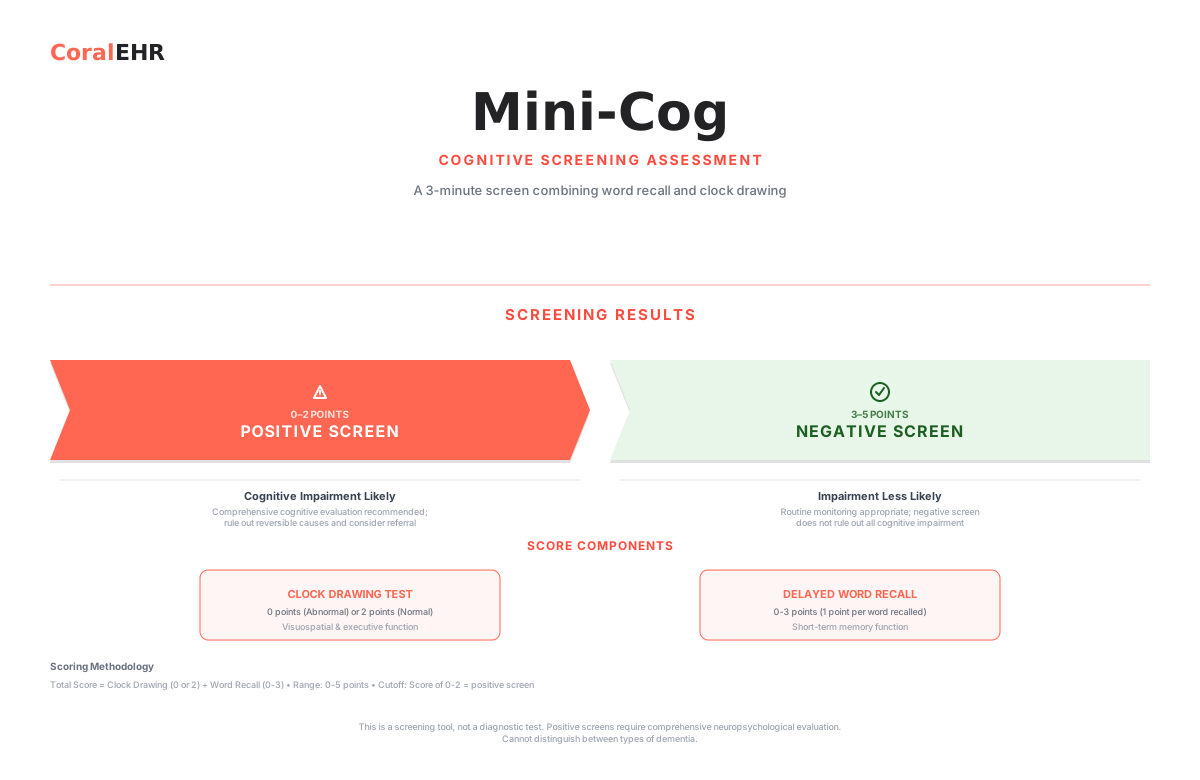
The Mini-Cog uses a simple binary classification based on total score:
Total Score: 0-2 points → POSITIVE SCREEN
- Interpretation: Positive screen for cognitive impairment. The score pattern suggests higher likelihood of clinically significant cognitive impairment.
- Clinical Action: Comprehensive cognitive evaluation recommended. Consider referral to neurology, neuropsychology, or geriatrics for further assessment.
- Follow-up: Rule out reversible causes (medication effects, delirium, depression, vitamin deficiencies, thyroid dysfunction).
Total Score: 3-5 points → NEGATIVE SCREEN
- Interpretation: Negative screen. Score suggests lower likelihood of dementia.
- Clinical Action: Routine monitoring as appropriate for age and risk factors.
- Important Note: A negative screen does NOT rule out all cognitive impairment. Some individuals with mild cognitive impairment or early dementia may still score in this range.
Score Component Breakdown:
Clock Drawing (0 or 2 points):
- 2 points (Normal): Intact visuospatial abilities, executive function, and ability to follow commands
- 0 points (Abnormal): Suggests deficits in visuospatial processing, executive function, or semantic memory
Delayed Recall (0-3 points):
- 3 points: Excellent short-term memory
- 1-2 points: Mild memory impairment
- 0 points: Significant memory deficit
Clinical Pearls:
- Isolated clock drawing impairment may suggest frontal/executive dysfunction
- Isolated recall impairment may suggest medial temporal (hippocampal) dysfunction
- Combined deficits increase likelihood of dementia
- Consider depression, anxiety, and test-taking factors that may affect performance
Next Steps After Positive Screen:
- Complete medical history and physical exam
- Laboratory workup (B12, thyroid, metabolic panel)
- Medication review
- Depression screening
- Comprehensive neuropsychological testing
- Brain imaging if indicated (MRI or CT)
Frequently Asked Questions
Common questions about the Mini-Cog assessment.


Stay Updated on Mental Health Resources
Get notified when we add new assessments, research insights, and mental health resources.