PCL-5: PTSD Checklist for DSM-5
The PCL-5 is a validated 20-item self-report tool for screening PTSD symptoms based on DSM-5 criteria. Get instant scoring with cluster breakdowns, severity levels, and downloadable results.

Understanding the PCL-5: PTSD Screening for DSM-5
The PTSD Checklist for DSM-5 (PCL-5) is a 20-item self-report questionnaire developed by the National Center for PTSD to assess symptoms of post-traumatic stress disorder. Each item corresponds directly to a DSM-5 PTSD symptom criterion, making it one of the most clinically validated trauma screening tools available.
Why the PCL-5 matters: PTSD affects approximately 6% of the U.S. population at some point in their lives, with rates significantly higher among veterans, first responders, and survivors of violence or disasters. Many people with PTSD symptoms don't seek help because they don't recognize their experiences as trauma-related. The PCL-5 provides an objective way to identify symptoms that warrant professional evaluation.
DSM-5 Symptom Clusters: The PCL-5 measures four distinct symptom clusters:
- Cluster B (Intrusion): Items 1-5 assess re-experiencing symptoms like intrusive memories, nightmares, flashbacks, and emotional/physical reactivity to trauma reminders.
- Cluster C (Avoidance): Items 6-7 measure avoidance of trauma-related thoughts, feelings, and external reminders.
- Cluster D (Negative Cognitions/Mood): Items 8-14 evaluate negative beliefs, distorted blame, persistent negative emotions, diminished interest, detachment, and inability to experience positive emotions.
- Cluster E (Arousal/Reactivity): Items 15-20 assess irritability, reckless behavior, hypervigilance, exaggerated startle response, concentration problems, and sleep disturbance.
Validation and reliability: The PCL-5 demonstrates excellent psychometric properties with strong internal consistency (Cronbach's alpha = 0.94-0.96) and test-retest reliability (r = 0.82-0.84). Research across diverse populations including veterans, civilians, and international samples confirms its diagnostic accuracy with an AUC of 0.89-0.95 for detecting PTSD. A cutoff score of 31-33 optimally balances sensitivity and specificity for most populations.
Clinical applications: The PCL-5 serves multiple purposes: initial screening, diagnostic support, symptom severity monitoring, and treatment outcome tracking. Clinicians often administer it at intake, throughout treatment, and at discharge to document progress. A 10-point change is considered clinically meaningful, while a 5-point change represents reliable change.
Important disclaimer: The PCL-5 is a screening and monitoring tool—it cannot diagnose PTSD. A comprehensive clinical evaluation including trauma history, symptom duration, functional impairment, and differential diagnosis is required for formal diagnosis. If you're experiencing severe symptoms or thoughts of self-harm, contact the 988 Suicide & Crisis Lifeline immediately.
Reference: This assessment is based on the official PCL-5 from the National Center for PTSD. The measure is in the public domain and may be used without permission.
Ready to Begin?
This assessment takes about 5-10 min to complete. Your responses are private, never stored, and you can instantly download your results as a PDF.
Pair PTSD screening with regulation planning
The PCL-5 measures PTSD symptom severity. For in-session psychoeducation or skills planning, use the window of tolerance tool to map hyperarousal, hypoarousal, body cues, triggers, and regulation strategies.
Open window of tolerance toolHow to Take the PCL-5 PTSD Assessment
Answer Questions
Complete the assessment honestly based on how you've been feeling
Get Your Score
Instant calculation using clinically validated scoring methods
Download PDF
Save or share your detailed results with your provider
You'll answer 20 questions about how much you've been bothered by specific PTSD symptoms during the past month. Each response is scored from 0 (Not at all) to 4 (Extremely), producing a total score between 0 and 80.
Before you begin: The PCL-5 asks about reactions to a "stressful experience." Think of the most distressing traumatic event you've experienced when answering. If you've experienced multiple traumas, you may focus on the one currently causing the most difficulty.
The 20 symptoms assessed include:
Re-experiencing (Cluster B):
- Intrusive memories of the trauma
- Distressing dreams related to the event
- Flashbacks (feeling like the trauma is happening again)
- Emotional distress when reminded of the trauma
- Physical reactions to trauma reminders
Avoidance (Cluster C):
- Avoiding trauma-related thoughts or feelings
- Avoiding external reminders (people, places, situations)
Negative Cognitions and Mood (Cluster D):
- Memory gaps about the trauma
- Negative beliefs about self, others, or the world
- Distorted blame regarding the trauma
- Persistent negative emotions
- Loss of interest in activities
- Feeling detached from others
- Difficulty experiencing positive emotions
Arousal and Reactivity (Cluster E):
- Irritability or angry outbursts
- Reckless or self-destructive behavior
- Hypervigilance
- Exaggerated startle response
- Concentration difficulties
- Sleep problems
Most people complete the assessment in 5-10 minutes.
PCL-5 Scoring and Clinical Interpretation
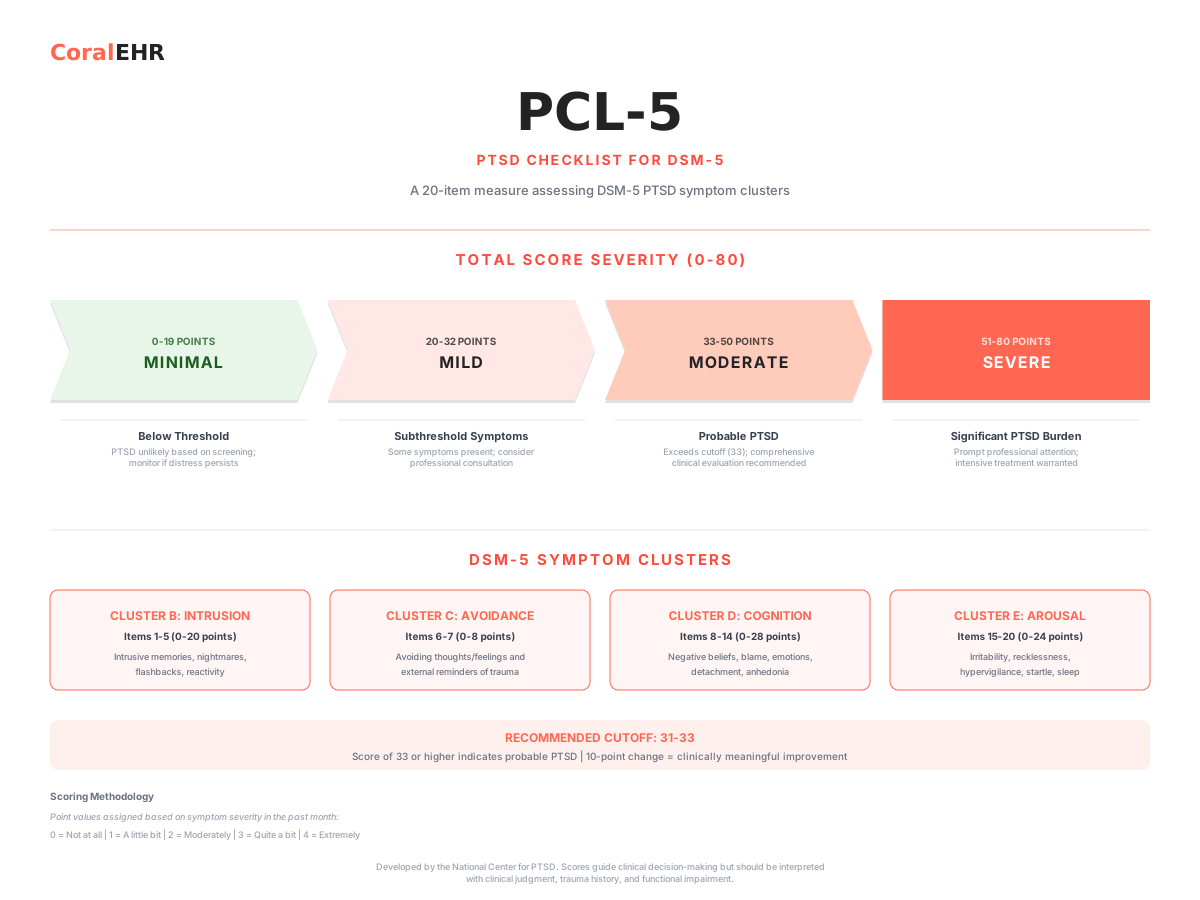
Total Score Interpretation (0-80):
0-19 (Minimal): Symptoms are below the clinical threshold. PTSD is unlikely based on this screening. However, even subclinical symptoms may benefit from support if they're causing distress.
20-32 (Mild to Subthreshold): Some PTSD symptoms are present but below the diagnostic cutoff. Monitor symptoms and consider professional consultation if they persist or worsen. Supportive interventions or psychoeducation may be helpful.
33-50 (Moderate - Probable PTSD): Score exceeds the suggested cutoff (31-33) at which clinical evaluation for PTSD is typically warranted. This is a probable-PTSD signal, not a diagnosis; only a structured clinical interview (e.g., CAPS-5) can confirm PTSD. Evidence-based treatments such as Cognitive Processing Therapy (CPT), Prolonged Exposure (PE), or EMDR are highly effective when PTSD is confirmed.
51-80 (Severe): Significant PTSD symptom burden requiring prompt professional attention. Intensive treatment and close monitoring are warranted. Safety planning should be considered if suicidal ideation is present.
Provisional DSM-5 Diagnosis Method:
The PCL-5 can also be scored categorically. Treating items rated 2 (Moderately) or higher as symptoms endorsed, a provisional PTSD diagnosis requires:
- At least 1 Cluster B item (questions 1-5)
- At least 1 Cluster C item (questions 6-7)
- At least 2 Cluster D items (questions 8-14)
- At least 2 Cluster E items (questions 15-20)
Cluster Subscores: Your results include separate scores for each DSM-5 symptom cluster, helping identify which symptom domains are most prominent. This can guide treatment focus—for example, high avoidance scores may benefit particularly from exposure-based therapies.
Monitoring treatment: A 10-point decrease from baseline indicates clinically meaningful improvement. Research suggests that achieving a score below 28 indicates transition to a non-clinical population.
Crisis support: If you're experiencing thoughts of suicide or self-harm, please call the 988 Suicide & Crisis Lifeline or go to your nearest emergency room immediately.
Frequently Asked Questions
Common questions about the PCL-5 assessment.
- A total of 40 falls in the 33-50 "Moderate" band, above the suggested 31-33 cutoff at which evaluation for PTSD is typically warranted. It signals probable PTSD and that a comprehensive clinical assessment is recommended. It is a screening result, not a diagnosis, since only a structured interview such as the CAPS-5 can confirm PTSD.
- No. The PCL-5 is a screening and symptom-monitoring tool, not a diagnostic test, so even a high score cannot confirm PTSD. A formal diagnosis requires a comprehensive clinical evaluation covering trauma history, symptom duration, functional impairment, and differential diagnosis. A score above the 31-33 cutoff means professional evaluation is advisable, not that PTSD is confirmed.
- The total-score cutoff (31-33) simply sums all 20 items and flags scores above the threshold as a probable-PTSD signal. The provisional DSM-5 method instead counts any item rated 2 (Moderately) or higher as an endorsed symptom and requires a specific pattern: at least 1 intrusion item (Q1-5), 1 avoidance item (Q6-7), 2 negative cognition/mood items (Q8-14), and 2 arousal items (Q15-20). Both are screening approximations, and neither replaces a structured clinical interview.
- The PCL-5 (PTSD Checklist for DSM-5) is a 20-item self-report questionnaire developed by the National Center for PTSD at the U.S. Department of Veterans Affairs. It was created to align with the updated PTSD criteria in DSM-5 (2013) and replaced the earlier PCL (for DSM-IV). The measure assesses all 20 DSM-5 PTSD symptoms across four symptom clusters: intrusion, avoidance, negative alterations in cognitions and mood, and alterations in arousal and reactivity. It is freely available in the public domain and has been translated into over 60 languages.
- Research suggests a cutoff score of **31-33** provides optimal diagnostic accuracy for most populations. A score of 33 or higher indicates probable PTSD and warrants comprehensive clinical evaluation. However, the optimal cutoff may vary by population—some studies recommend 31 for veteran samples and 33 for civilian samples. Lower cutoffs (28-30) may be appropriate when maximizing sensitivity is prioritized, such as in screening programs where false negatives are more costly than false positives.
- The PCL-5 demonstrates strong diagnostic accuracy when compared to structured clinical interviews like the Clinician-Administered PTSD Scale (CAPS-5). Studies report sensitivity of 78-94% and specificity of 73-95%, depending on the cutoff score and population. The area under the ROC curve (AUC) typically ranges from 0.89-0.95, indicating excellent discriminative ability. However, the PCL-5 is a screening tool—a positive screen should always be followed by comprehensive clinical evaluation to confirm diagnosis and rule out other conditions.
- Yes, the PCL-5 is widely used to track treatment outcomes. A **10-point change** is considered a clinically meaningful difference, while a **5-point change** represents reliable change (beyond measurement error). Clinicians typically administer the PCL-5 at intake, regularly during treatment (every 2-4 weeks), and at discharge. Achieving a score below 28 suggests the individual has transitioned to a non-clinical symptom level. Tracking cluster subscores can also reveal which symptom domains are responding to treatment.
- The PC-PTSD-5 (Primary Care PTSD Screen) is a brief 5-item screener designed for rapid screening in primary care settings. It takes about 1-2 minutes versus 5-10 minutes for the full PCL-5. A positive PC-PTSD-5 screen (score of 3 or higher) should be followed up with the full PCL-5 for more detailed symptom assessment. The PCL-5 provides severity information and cluster subscores that the PC-PTSD-5 cannot. Use PC-PTSD-5 for initial triage; use PCL-5 for comprehensive assessment and ongoing monitoring.
- Yes. After completing the assessment, you can download your results as a professional PDF report that includes your total score, severity level, all four cluster subscores, clinical interpretation, and your responses to each question. The PDF can be shared with your healthcare provider, therapist, or VA counselor, or kept for your personal records to track changes over time.
- Your responses are processed entirely in your browser - nothing is transmitted to or stored on our servers, so no protected health information leaves your device. Note: HIPAA compliance is a property of an organization's policies and Business Associate Agreements, not of a website. Clinicians using this tool inside a practice should follow their EHR's HIPAA workflow.
- For treatment monitoring, the PCL-5 is typically administered every 2-4 weeks. Since the questionnaire asks about symptoms over the past month, taking it more frequently than every 2 weeks may not capture meaningful change. For periodic self-monitoring outside of treatment, monthly administration is reasonable. If you notice significant worsening of symptoms between scheduled assessments, it's appropriate to retake the measure and share results with your provider.
- Yes, the PCL-5 can be used for any type of traumatic experience including combat, sexual assault, accidents, natural disasters, childhood abuse, witnessing violence, or other life-threatening events. The questions assess PTSD symptoms without being specific to any particular trauma type. However, for some populations, specialized assessments may provide additional value—for example, measures that assess complex PTSD symptoms for survivors of prolonged interpersonal trauma.


Stay Updated on Mental Health Resources
Get notified when we add new assessments, research insights, and mental health resources.