Mini-Cog: Mini-Cog Cognitive Assessment
Clinician scoring worksheet for Mini-Cog© word recall and clock drawing. Not a self-test.
Mini-Cog: A Rapid 3-Minute Cognitive Screening Tool
Overview: The Mini-Cog is a brief cognitive screening instrument that combines a three-item recall test with a clock drawing test. It was developed in 2000 and takes about 3 minutes to administer. It is a screen, not a diagnosis.
Clinical Background: The Mini-Cog was designed to detect cognitive impairment in older adults. It is meant to be given quickly by a clinician. A positive screen still needs a fuller evaluation.
Evidence & Validation: Abayomi et al. (PLoS One, 2024) pooled Mini-Cog accuracy in adults 60 and older. For dementia (six studies, n=4,772) they reported 76% sensitivity and 83% specificity (doi:10.1371/journal.pone.0298686). A primary-care figure of 73% sensitivity / 84% specificity mixed MCI, dementia, and undifferentiated cognitive impairment; it is not a dementia-only result. The MCI pooled estimate (two studies, n=270) is too small to treat as settled. mini-cog.com states there is insufficient evidence to recommend Mini-Cog for MCI screening. The review also noted high or unclear risk of bias in patient selection and timing. Mini-Cog is a screen, not a diagnostic test, and is not claimed to outperform longer instruments.
Components:
- Three-Word Recall: Tests short-term memory by asking patients to remember and later recall three unrelated words
- Clock Drawing Test: Assesses visuospatial abilities, executive function, and semantic memory by having patients draw a clock face showing a specific time
Why Use the Mini-Cog?
- Faster than MMSE (3 minutes vs. 8-10 minutes)
- Less influenced by education level or language
- Free for clinical and educational use (Mini-Cog© is still copyrighted)
- Validated across diverse populations
- Easy to administer and score
- Can be used for screening and progress monitoring
Copyright: Mini-Cog© is copyrighted by Soo Borson, MD. It is made available free of charge for clinical and educational use so the test is given and scored as written. This page is a clinician scoring aid, not a substitute for the official instrument at mini-cog.com. It is not a self-test.
Appropriate Use Cases:
- Primary care cognitive screening
- Annual wellness visits for older adults
- Monitoring progression in known cognitive impairment
- Pre-surgical cognitive baseline
- Emergency department cognitive assessment
Important Limitations:
- This is a screening tool, NOT a diagnostic test
- Positive screens require comprehensive neuropsychological evaluation
- Cannot distinguish between types of dementia
- May miss subtle or domain-specific impairments
- Should not be used alone for clinical decision-making
Crisis Resources: If you or someone you know is experiencing severe confusion, sudden cognitive changes, or other concerning symptoms, seek immediate medical attention by calling 911 or going to the nearest emergency room.
Ready to Begin?
This assessment takes about 3 min to complete. Your responses are private, never stored, and you can instantly download your results as a PDF.
How to score a clinician-administered Mini-Cog©
Clinician administers
Read the official Mini-Cog© word list aloud. Do not show this screen to the person being screened.
Score clock and recall
Official clock scoring is 0 or 2; delayed free recall is 0–3. No cues. Hand length is not scored.
Download a scoring worksheet
Save a screening worksheet. Do not file a self-administered result as a clinician Mini-Cog©.
The Mini-Cog has 3 steps and takes approximately 3 minutes. Do not show this screen to the person being screened.
Step 1: Word Registration (Not Scored)
- Read three words aloud from an official Mini-Cog© word list
- The person repeats them back to confirm they heard correctly
- Do not leave the word list visible. This step is not scored yet
Step 2: Clock Drawing Test (0 or 2 points)
- Ask the person to draw a clock showing 10 past 11 (11:10)
- The drawing creates the delay before recall
- Normal clock (2 points): Numbers 1–12 once, clockwise, roughly correct positions; one hand to the 11 and one hand to the 2
- Abnormal clock (0 points): Any other clock, or refusal
- Hand length is not scored
Step 3: Delayed Recall (0-3 points)
- Ask: "What were the 3 words I asked you to remember?"
- 1 point per word recalled without cues
- Only free recall counts (no hints, category cues, or multiple choice)
Total Score: Clock score (0 or 2) + Recall score (0-3) = 0-5 points
After scoring: Instant results show:
- Clock drawing score
- Delayed recall score (number of words remembered)
- Total Mini-Cog score
- Interpretation (positive or negative screen)
- A screening worksheet PDF. Do not file a self-administered result as a clinician-given Mini-Cog©.
Mini-Cog Scoring and Clinical Interpretation
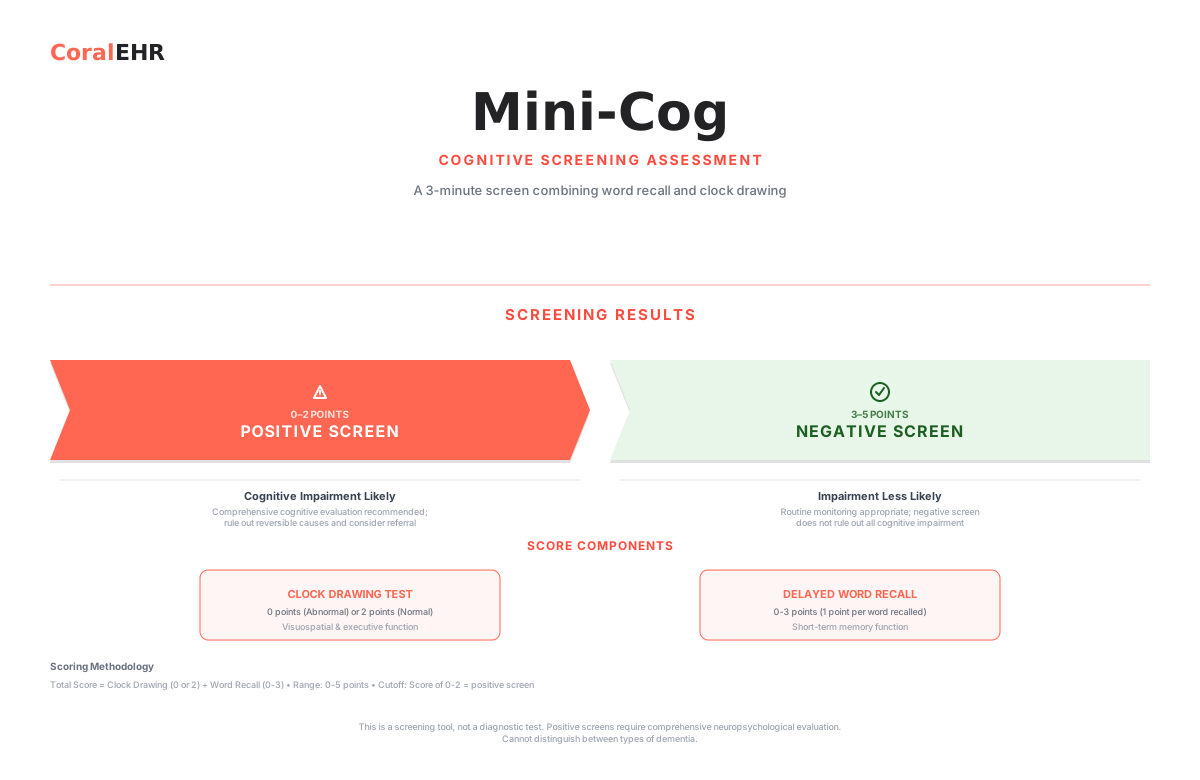
The Mini-Cog uses a simple binary classification based on total score:
Total Score: 0-2 points → POSITIVE SCREEN
- Interpretation: Positive screen for cognitive impairment. The score pattern suggests higher likelihood of clinically significant cognitive impairment.
- Clinical Action: Comprehensive cognitive evaluation recommended. Consider referral to neurology, neuropsychology, or geriatrics for further assessment.
- Follow-up: Rule out reversible causes (medication effects, delirium, depression, vitamin deficiencies, thyroid dysfunction).
Total Score: 3-5 points → NEGATIVE SCREEN
- Interpretation: Negative screen. Score suggests lower likelihood of dementia.
- Clinical Action: Routine monitoring as appropriate for age and risk factors.
- Important Note: A negative screen does NOT rule out all cognitive impairment. Some individuals with mild cognitive impairment or early dementia may still score in this range.
Score Component Breakdown:
Clock Drawing (0 or 2 points):
- 2 points (Normal): Intact visuospatial abilities, executive function, and ability to follow commands
- 0 points (Abnormal): Suggests deficits in visuospatial processing, executive function, or semantic memory
Delayed Recall (0-3 points):
- Official Mini-Cog© scoring awards 1 point per word freely recalled. It does not publish separate “mild / significant memory impairment” labels for the recall item alone.
- Use the total 0–2 vs 3–5 cut, not an unofficial recall-only severity band.
Clinical notes (not official Mini-Cog© scoring):
- Isolated clock-drawing errors can raise a question about visuospatial or executive demand
- Isolated recall errors can raise a question about memory
- Combined deficits increase concern for a dementia syndrome
- Depression, delirium, hearing, language, and test-taking factors can all affect performance
Next Steps After Positive Screen:
- Complete medical history and physical exam
- Laboratory workup (B12, thyroid, metabolic panel)
- Medication review
- Depression screening
- Comprehensive neuropsychological testing
- Brain imaging if indicated (MRI or CT)
Frequently Asked Questions
Common questions about the Mini-Cog assessment.
- A 2024 systematic review (Abayomi et al., PLoS One) reported 76% sensitivity and 83% specificity for dementia across six studies. Do not cite the 73%/84% primary-care pool as a dementia figure; it mixed MCI, dementia, and other cognitive impairment. mini-cog.com says there is insufficient evidence for MCI screening. Mini-Cog is a screen, not a diagnosis.
- No. The Mini-Cog is a screening tool that detects the presence of cognitive impairment but cannot distinguish between types of dementia (Alzheimer's, vascular, Lewy body, frontotemporal, etc.). Differential diagnosis requires comprehensive evaluation including history, neuroimaging, and specialized testing.
- The Mini-Cog is less influenced by education and language than some other cognitive tests. However, the clock drawing component requires basic visuospatial abilities and understanding of clock concepts. Modified versions exist for non-literate populations.
- Yes, the Mini-Cog can be used for serial monitoring, though more comprehensive instruments may be better for tracking subtle changes. Reassessment every 6-12 months is common in individuals with known cognitive impairment.
- Score the clock drawing as 0 (abnormal) if refused or if physical limitations prevent completion. Note the reason for non-completion. Consider alternative cognitive screening tools that don't require drawing, such as verbal-only assessments.
- Yes, Mini-Cog© is copyrighted by Soo Borson, MD. The copyright exists so the test is administered and scored as written, not to charge clinicians. Clinical and educational use is free. Use the official instrument and scoring rules at mini-cog.com. This page is a scoring aid, not a license to reprint or self-administer the test.
- Yes. After scoring, you can download a PDF with clock score, recall score, total score, and the official 0–2 vs 3–5 screen interpretation. Treat it as a screening worksheet, not a diagnostic report, and do not put a self-administered result in a medical record as if it were a clinician-given Mini-Cog©.
- Your responses are processed entirely in your browser - nothing is transmitted to or stored on our servers, so no protected health information leaves your device. Note: HIPAA compliance is a property of an organization's policies and Business Associate Agreements, not of a website. Clinicians using this tool inside a practice should follow their EHR's HIPAA workflow.


Stay Updated on Mental Health Resources
Get notified when we add new assessments, research insights, and mental health resources.