RSES: Rosenberg Self-Esteem Scale
The Rosenberg Self-Esteem Scale is the most widely used measure of global self-esteem. Answer 10 questions to assess your sense of self-worth with instant results.
Rosenberg Self-Esteem Scale: The Gold Standard for Measuring Self-Worth
The Rosenberg Self-Esteem Scale (RSES) is the most widely used measure of global self-esteem in psychology. Developed by sociologist Dr. Morris Rosenberg in 1965, this brief 10-item questionnaire assesses your overall sense of self-worth and self-acceptance. It has been used in thousands of research studies and remains the gold standard for measuring self-esteem across clinical, educational, and research settings.
What it measures: The RSES captures your "positive or negative attitude toward the self as a totality." Rather than measuring specific aspects of self-concept (like appearance or abilities), it assesses your overall feelings of self-worth and self-acceptance. This makes it particularly valuable for tracking changes in global self-esteem over time.
Evidence & validation: The RSES demonstrates excellent psychometric properties with Cronbach's alpha ranging from 0.77 to 0.88 across diverse samples. Test-retest reliability is consistently strong (0.82-0.88), indicating stable measurement over time. The scale has been validated across cultures, age groups, and clinical populations, appearing in over 50,000 published studies.
Clinical relevance: Research consistently links low self-esteem to depression, anxiety, and psychological distress. Importantly, low self-esteem prospectively predicts later depressive symptoms, independent of prior mood states. This makes tracking self-esteem valuable for identifying vulnerability and measuring treatment progress.
Why therapists use it: The RSES is ideal for private practice because it's quick (2-3 minutes), free to use, and sensitive to change. Many therapists administer it at intake and periodically throughout treatment to demonstrate progress. Clients often find it validating to see their self-esteem improve over the course of therapy.
Important disclaimer: The RSES measures perceived self-esteem, not objective self-worth. Low scores don't mean you lack value—they indicate you're experiencing negative self-perception that therapy can address. If your score suggests low self-esteem, consider speaking with a mental health professional. In the U.S., call the 988 Suicide & Crisis Lifeline for support.
Reference: Rosenberg, M. (1965). Society and the Adolescent Self-Image. Princeton, NJ: Princeton University Press.
Ready to Begin?
This assessment takes about 2-3 min to complete. Your responses are private, never stored, and you can instantly download your results as a PDF.
How to Take the Rosenberg Self-Esteem Scale Online
Answer Questions
Complete the assessment honestly based on how you've been feeling
Get Your Score
Instant calculation using clinically validated scoring methods
Download PDF
Save or share your detailed results with your provider
You'll answer 10 statements about how you feel about yourself. For each statement, indicate how strongly you agree or disagree on a 4-point scale:
- Strongly Agree
- Agree
- Disagree
- Strongly Disagree
The RSES includes statements like:
- "On the whole, I am satisfied with myself"
- "I feel that I have a number of good qualities"
- "I am able to do things as well as most other people"
- "I take a positive attitude toward myself"
Scoring note: Five items are worded positively (agreeing indicates higher self-esteem) and five are worded negatively (agreeing indicates lower self-esteem). The negative items are automatically reverse-scored so that higher total scores always indicate higher self-esteem.
Total scores range from 0 to 30, with higher scores indicating greater self-esteem. Most people complete the assessment in 2-3 minutes. Rosenberg published the 0–30 total, not clinical Low / Normal / High cutoffs. The 0–14 / 15–25 / 26–30 bands below are commonly used and unofficial.
RSES Scoring Guidelines and Clinical Interpretation
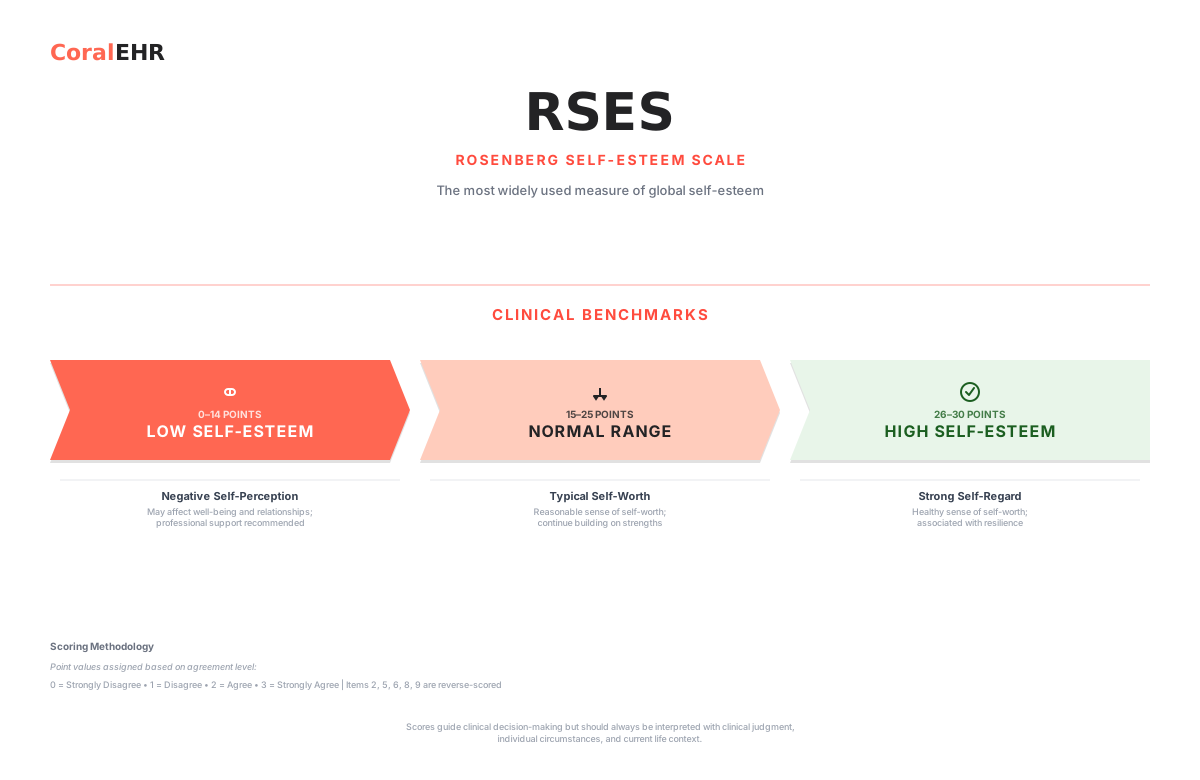
Rosenberg did not publish official Low / Normal / High cutoffs. The bands below are commonly used in practice and on this page. Treat them as unofficial context around the 0–30 total, not a diagnosis.
0-14 (unofficial: Low Self-Esteem): Your score is in a commonly used low band. That can go with more negative self-perception. It is not a diagnosis. Professional support can help you develop a more balanced view of yourself.
15-25 (unofficial: Normal Range): Your score is in a commonly used mid band. Many adults land here and still have areas of self-doubt.
26-30 (unofficial: High Self-Esteem): Your score is in a commonly used high band. That usually goes with stronger self-regard. It is still not a diagnosis.
Important context: Self-esteem naturally fluctuates based on life circumstances. A temporarily lower score during a difficult period doesn't define your worth. The RSES is most valuable when used to track changes over time rather than as a single diagnostic measure.
Using your results: If you're working with a therapist, share your score to inform treatment planning. Retaking the RSES every 4-6 weeks can help track progress and demonstrate the impact of therapy on your self-perception.
What affects self-esteem: Self-esteem is shaped by early experiences, relationships, achievements, and how we interpret life events. Cognitive-behavioral therapy, self-compassion practices, and addressing underlying depression or anxiety can all improve self-esteem over time.
Frequently Asked Questions
Common questions about the RSES assessment.
- A score of 12 is in the commonly used unofficial 0–14 low band. Rosenberg published the 0–30 total, not that cutoff. The result is a screening signal, not a diagnosis, and a single low score does not define your worth.
- No. The Rosenberg Self-Esteem Scale is a brief screening measure of how you currently perceive your own self-worth, not a diagnostic instrument. A low score (0-14) indicates negative self-perception that is worth attention, but only a qualified clinician can evaluate whether an underlying condition like depression or anxiety is present. Use your result as a starting point for conversation, not a verdict.
- Five RSES items are worded positively (like "I take a positive attitude toward myself") and five are worded negatively (like "At times, I think I am no good at all"). The negatively worded items are reverse-scored so that, on every item, more self-worth earns more points. This balanced wording reduces the chance of answering on autopilot and ensures your final 0-30 total always reads in the same direction, with higher meaning greater self-esteem.
- The RSES is highly reliable with internal consistency (Cronbach's alpha) of 0.77-0.88 across thousands of studies. Test-retest reliability ranges from 0.82-0.88, meaning it produces consistent results over time. It's been validated across diverse cultures, age groups, and clinical populations, making it the most trusted measure of global self-esteem available.
- Yes, the RSES is excellent for tracking therapy outcomes. Many therapists administer it at intake and every 4-6 weeks throughout treatment to objectively measure changes in self-esteem. Research shows the scale is sensitive to therapeutic change. Consider pairing with the [PHQ-9](/assessments/phq-9/) since low self-esteem and depression frequently co-occur.
- Self-esteem (measured by the RSES) is your overall sense of self-worth—do you feel you are a person of value? Self-confidence is your belief in your abilities to accomplish specific tasks. Someone can have high self-confidence in their work skills but low overall self-esteem. The RSES measures global self-worth rather than domain-specific confidence.
- Yes. After completing the assessment, you can download your results as a professional PDF report that includes your total score, interpretation, and individual responses. This PDF can be shared with your therapist or kept for tracking progress over time.
- Your responses are processed entirely in your browser - nothing is transmitted to or stored on our servers, so no protected health information leaves your device. Note: HIPAA compliance is a property of an organization's policies and Business Associate Agreements, not of a website. Clinicians using this tool inside a practice should follow their EHR's HIPAA workflow.
- For ongoing monitoring, taking the RSES every 4-6 weeks provides useful tracking of self-esteem changes. This frequency allows enough time for meaningful change while capturing the impact of therapy or life events. If you're working with a therapist, coordinate timing with your sessions.
- Yes, the RSES was originally developed with adolescents and has been validated for ages 12 and above. It's widely used in school counseling and adolescent mental health settings. The straightforward language makes it accessible for younger individuals while remaining appropriate for adults of all ages.
- Yes. Research demonstrates that self-esteem can improve through therapy, particularly cognitive-behavioral therapy, self-compassion training, and addressing underlying mood disorders. Studies show meaningful increases in RSES scores following successful treatment. While self-esteem tends to be relatively stable, it is not fixed—positive experiences and therapeutic work can genuinely shift your self-perception.
- The RSES measures global self-esteem (your overall sense of self-worth), while the [PHQ-9](/assessments/phq-9/) screens specifically for depression symptoms. Low self-esteem and depression often co-occur but are distinct constructs—you can have low self-esteem without clinical depression, and depression without severely low self-esteem. Many clinicians use both assessments together since they provide complementary information.


Stay Updated on Mental Health Resources
Get notified when we add new assessments, research insights, and mental health resources.