PC-PTSD-5: Primary Care PTSD Screen for DSM-5
The PC-PTSD-5 is a brief 5-item yes/no screening tool designed for rapid PTSD detection in primary care settings. Get instant results with scoring interpretation.
Understanding the PC-PTSD-5: A Brief PTSD Screening Tool
The Primary Care PTSD Screen for DSM-5 (PC-PTSD-5) is a 5-item screening questionnaire developed by the National Center for PTSD at the U.S. Department of Veterans Affairs. Designed specifically for rapid screening in primary care and other medical settings, it helps identify individuals who may have PTSD and would benefit from further evaluation.
Why the PC-PTSD-5 matters: PTSD often goes undetected in primary care settings because patients may not connect their symptoms to past traumatic experiences, or clinicians may not have time for comprehensive assessments. The PC-PTSD-5 provides a quick, validated method to identify probable PTSD in just 1-2 minutes, enabling appropriate referrals for comprehensive evaluation.
DSM-5 Alignment: The PC-PTSD-5 was updated from the original 4-item PC-PTSD to align with DSM-5 diagnostic criteria. The five items assess key PTSD symptom domains:
- Re-experiencing (Item 1): Intrusive memories and nightmares
- Avoidance (Item 2): Avoiding trauma-related thoughts and reminders
- Hyperarousal (Item 3): Hypervigilance and startle response
- Numbing (Item 4): Emotional detachment and disconnection
- Negative cognitions (Item 5): Guilt and distorted blame (new in DSM-5)
Validation and reliability: The PC-PTSD-5 demonstrates excellent diagnostic accuracy. In validation studies with VA primary care patients, a cut-off score of 3 achieved 95% sensitivity and 85% specificity with an area under the curve (AUC) of 0.941. This means the screen correctly identifies most people with PTSD while minimizing false positives.
When to use the PC-PTSD-5: This brief screener is ideal for:
- Initial triage in primary care settings
- Emergency department screening
- Community health screenings
- Annual wellness visits
- Any situation requiring rapid PTSD assessment
For comprehensive symptom assessment and treatment monitoring, the longer PCL-5 (PTSD Checklist) provides more detailed information including symptom severity and cluster subscores.
Important disclaimer: The PC-PTSD-5 is a screening tool, not a diagnostic instrument. A positive screen indicates probable PTSD that warrants comprehensive evaluation by a qualified mental health professional. If you're experiencing severe symptoms or thoughts of self-harm, contact the 988 Suicide & Crisis Lifeline immediately.
Reference: This assessment is based on the official PC-PTSD-5 from the National Center for PTSD. The measure is in the public domain and may be used without permission.
Ready to Begin?
This assessment takes about 1-2 min to complete. Your responses are private, never stored, and you can instantly download your results as a PDF.
How to Take the PC-PTSD-5 Screening Test
Answer Questions
Complete the assessment honestly based on how you've been feeling
Get Your Score
Instant calculation using clinically validated scoring methods
Download PDF
Save or share your detailed results with your provider
The PC-PTSD-5 begins by asking whether you have ever experienced a traumatic event. Traumatic events include:
- Serious accidents or injuries
- Physical or sexual assault
- Natural disasters (earthquakes, floods, fires)
- War or combat exposure
- Witnessing someone being seriously injured or killed
- Learning about the violent or sudden death of a loved one
If you have experienced trauma, you'll answer 5 yes/no questions about symptoms you've experienced in the past month related to that trauma.
The 5 symptom areas assessed:
- Intrusive thoughts and nightmares - Unwanted memories or dreams about the traumatic event(s)
- Avoidance - Actively trying not to think about the event or avoiding reminders
- Hypervigilance - Being constantly on guard, watchful, or easily startled
- Emotional numbing - Feeling detached from people, activities, or surroundings
- Guilt and blame - Feeling guilty or blaming yourself or others for the event or its consequences
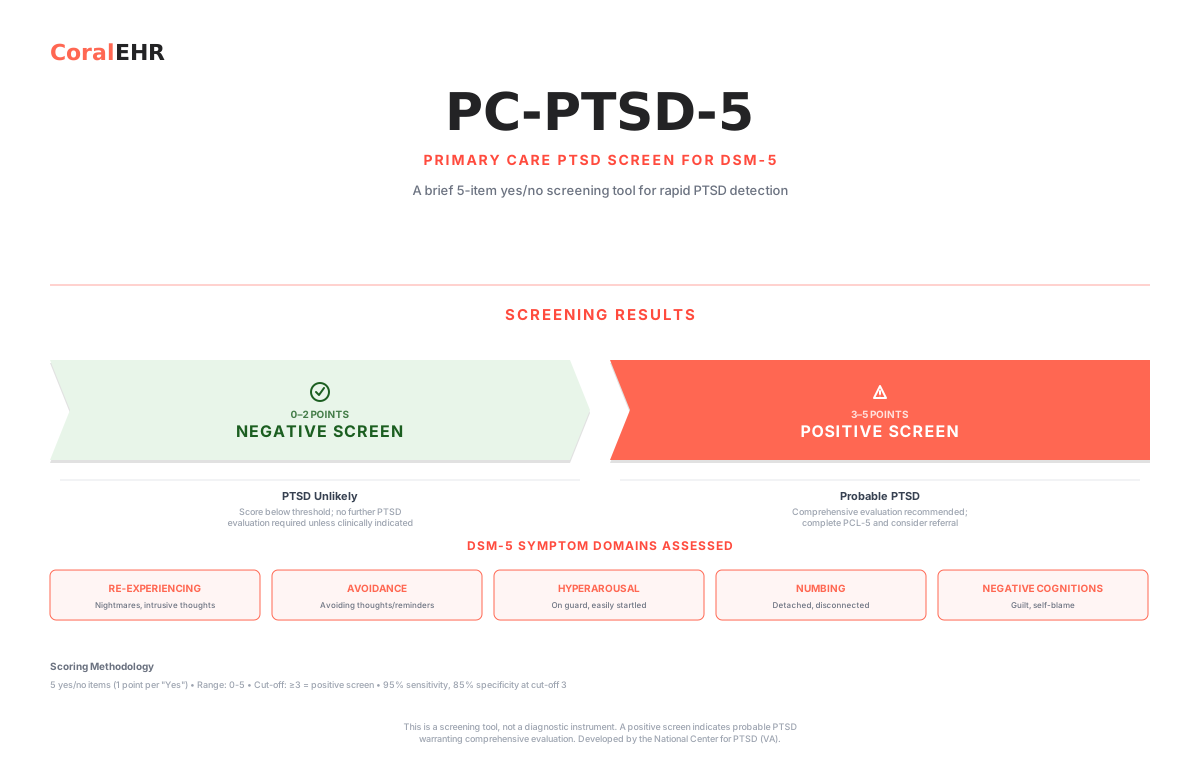
Scoring: Each "Yes" answer counts as 1 point, producing a total score from 0 to 5. A score of 3 or higher indicates a positive screen for probable PTSD.
Most people complete this screening in 1-2 minutes.
PC-PTSD-5 Scoring and Clinical Interpretation
Scoring Overview:
The PC-PTSD-5 uses simple yes/no responses. Count the number of "Yes" answers to determine the total score (0-5).
Score of 0-2 (Negative Screen):
A score below 3 indicates that PTSD is unlikely based on this screening. However, this does not rule out other mental health concerns or subclinical trauma symptoms that may still benefit from support. If you're experiencing distress related to past experiences, consider discussing this with a healthcare provider.
Score of 3-5 (Positive Screen):
A score of 3 or higher indicates probable PTSD and warrants comprehensive evaluation. Research shows this cut-off achieves:
- 95% sensitivity (catches most true cases)
- 85% specificity (reasonable false positive rate)
- 86% overall diagnostic efficiency
What a positive screen means:
A positive PC-PTSD-5 does not diagnose PTSD. It indicates a high likelihood that a comprehensive clinical evaluation would confirm PTSD. Recommended next steps include:
- Complete the full PCL-5 - The PTSD Checklist for DSM-5 provides detailed symptom severity and cluster subscores
- Seek professional evaluation - A structured clinical interview (such as the CAPS-5) can confirm diagnosis
- Consider treatment options - Evidence-based treatments like Cognitive Processing Therapy (CPT), Prolonged Exposure (PE), and EMDR are highly effective for PTSD
Cut-off considerations:
While a cut-off of 3 is recommended for general screening (maximizing sensitivity), some contexts may warrant different thresholds:
- Cut-off of 4: Better balances sensitivity (83%) and specificity (91%), reducing false positives
- Cut-off of 3 for women: Research suggests women may be underdetected at higher cut-offs
Crisis support: If you're experiencing thoughts of suicide or self-harm, please call the 988 Suicide & Crisis Lifeline or go to your nearest emergency room immediately.
Frequently Asked Questions
Common questions about the PC-PTSD-5 assessment.
- The PC-PTSD-5 (Primary Care PTSD Screen for DSM-5) is a 5-item screening questionnaire developed by the National Center for PTSD at the U.S. Department of Veterans Affairs. It was created to provide a brief, validated method for detecting probable PTSD in primary care and other medical settings. The PC-PTSD-5 updated the original 4-item PC-PTSD to align with DSM-5 criteria, adding an item assessing guilt and blame. It is freely available in the public domain and mandated for use in VA and DoD healthcare settings.
- A score of **3 or higher** (answering "Yes" to 3 or more of the 5 questions) indicates a positive screen for probable PTSD. This cut-off was selected to maximize sensitivity (95%) while maintaining acceptable specificity (85%), ensuring most people with PTSD are identified for further evaluation. A cut-off of 4 provides better specificity (91%) but lower sensitivity (83%), which may be preferred in settings where reducing false positives is important.
- The PC-PTSD-5 demonstrates excellent diagnostic accuracy when validated against structured clinical interviews. Studies report an area under the curve (AUC) of 0.941, indicating excellent discriminative ability. At a cut-off of 3, sensitivity is 95% and specificity is 85%. However, the PC-PTSD-5 is a screening tool, not a diagnostic instrument. A positive screen should always be followed by comprehensive clinical evaluation using tools like the CAPS-5 (Clinician-Administered PTSD Scale) to confirm diagnosis.
- The **PC-PTSD-5** is a brief 5-item yes/no screener designed for rapid triage in primary care (1-2 minutes). It identifies probable PTSD but doesn't assess symptom severity. The **PCL-5** is a comprehensive 20-item assessment with 5-point severity ratings (5-10 minutes) that provides total scores, severity levels, and cluster subscores for all four DSM-5 symptom categories. Use the PC-PTSD-5 for initial screening; use the [PCL-5](/assessments/pcl-5) for detailed assessment, treatment planning, and progress monitoring.
- The PC-PTSD-5 is not designed for treatment monitoring because its yes/no format doesn't capture symptom severity changes. For tracking treatment progress, use the [PCL-5](/assessments/pcl-5), which provides severity ratings that can detect clinically meaningful change (10-point improvement). The PC-PTSD-5 is best suited for initial screening and periodic re-screening to detect new or recurring PTSD symptoms.
- Yes. After completing the assessment, you can download your results as a professional PDF report that includes your total score, screen result (positive or negative), clinical interpretation, and your responses to each question. The PDF can be shared with your healthcare provider, therapist, or VA counselor, or kept for your personal records.
- Your responses are processed entirely in your browser - nothing is transmitted to or stored on our servers, so no protected health information leaves your device. Note: HIPAA compliance is a property of an organization's policies and Business Associate Agreements, not of a website. Clinicians using this tool inside a practice should follow their EHR's HIPAA workflow.
- The PC-PTSD-5 asks about symptoms "in the past month," so taking it more frequently than monthly is unlikely to show meaningful change. In primary care settings, annual screening is common. If you've experienced a new traumatic event, or if symptoms have changed significantly, rescreening is appropriate. For ongoing symptom monitoring during treatment, the [PCL-5](/assessments/pcl-5) is more suitable.
- Yes, the PC-PTSD-5 can be used for any type of traumatic experience including combat, sexual assault, accidents, natural disasters, childhood abuse, witnessing violence, or learning about the violent death of a loved one. The questions assess general PTSD symptoms without being specific to any particular trauma type. The screening preamble provides examples of traumatic events to help respondents understand what qualifies as trauma.


Stay Updated on Mental Health Resources
Get notified when we add new assessments, research insights, and mental health resources.